The Festival of Lights at the Glorious Gwalior Fort- Bandi Chod Diwas
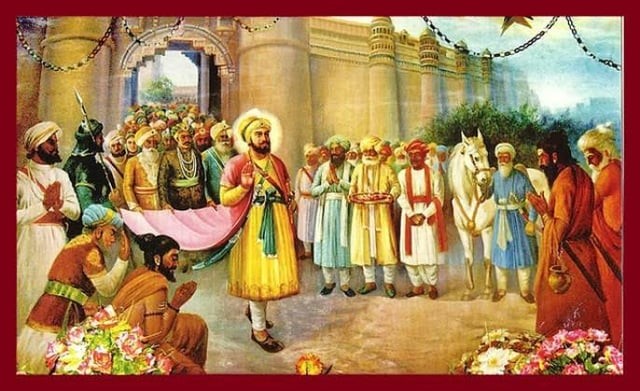
On this day, illumination of diyas at the Fort and in the homes of the Sikh community marks the glorious freedom of the 52 Kings from the Gwalior Fort, who were imprisoned and tortured by Jahangir Khan, in vengeance for their conversion to Islam, to mark the expansion of his reign. The 6th Sikh Guru, Guru Hargobind Sahib ji, along with the 52 princes, were welcomed with diyas, a shower of flowers and the distribution of sweets upon release at the Gwalior Fort and on his way to Amritsar.
The Fort of Gwalior, also recognised as ‘pearl amongst the fortresses of Hind’, was raised as a defence hill fort in the 6th century. Its insurmountability and grandeur earned it the name ‘Gibraltar of India‘. Recorded as Gopgiri in Sanskrit inscriptions, the Fort’s rich history is marked by characters of war, defence, brutal acts of killings, savage punishments, and the conquest of regions. Ironically, the release of 52 kings and Guru Hargobind Sahib ji from the Gwalior Fort took place without any battle or war.
The city got its name from a sage named Gwalipa, who treated the local king Suraj Sen of a deadly disease called leprosy by bathing in a sacred pool named Suraj Kund which exists today. Hence, the enormous Fort was named Gwalior Fort or Fort of Gwalior to honour the sage.
The current structure of the Fort has existed at least since the 8th century, and the inscriptions and monuments found within what is now the fort campus indicate that it may have existed as early as the beginning of the 6th century, making it one of India’s oldest defence forts still in existence. The Vindhyan sandstone fortress has witnessed the varying fortunes of the English, the Guptas, the Hunas, the Jats, the Kachchhapaghatas, the Kushanas, the Nagas, the Marathas, the Mughals, the Pratiharas, the Tomaras, the Pathans, and the Surs. The larger-than-life representation of the powerful Scindia dynasty has left its mark on various well-preserved monuments.
The Gwalior Fort showcases the magnificence of various kingdoms, as it is a defensive fort, aligned with wars and battles in the quest for victory. However, such a monument can also serve as a testament to courage, devotion, love, and enlightenment, and is an irony that deserves to be revered and celebrated throughout.
Sikhs celebrate this day to salute Guru Hargobind Ji’s valorous act of releasing 52 kings and princes from Emperor Jehangir’s capture. Jehangir had a hawk’s eye on Guru Hargobind Sahib ji following the succession to the throne, an outcome of the execution of his father and the fifth Sikh Guru, Guru Arjan Dev, in 1606 CE. At his succession ceremony, he put on two swords: one indicated his spiritual authority (piri) and the other, his temporal authority (miri).
At the age of 11, Guru Hargobind Sahib ji committed himself to developing his military’s strength to the maximum capacity, as his father’s gruesome death thrust him. Nonetheless, Guru Hargobind Singh’s emphasis on spiritual authority posed a significant threat to Jehangir and a glaring red flag for the other rulers. Consequently, he established and raised Sri Akal Takhat Sahib (The Throne of the Almighty) in Amritsar.
Consequently, Murtuja Khan, the Nawab of Lahore, informed Emperor Jehangir about the rising power of Guru Hargobind Sahib ji.
Jehangir’s highly dominant and insecure reaction stunned the kingdom. He ordered his confidant, Wazir Khan, to arrest Guru Hargobind. However, Wazir greatly admired the Guru. So he invited him to meet the Emperor in Delhi, which he accepted. When the young Guru arrived at Jehangir’s court, he was betrayed and ensnared in the Gwalior Fort, where 52 kings and princes from various Rajput and other kingdoms were imprisoned. In the subterranean chambers of Man Singh Palace, the prisoners were tied to heavy chains and brutally tortured. Prisoners were punished with burdensome labour work like grinding stones, pathetic living conditions, and starved to survive on limited water. The barbarous acts of Jehangir are still evident today, as you can see the carved effects of the chains on the 52 pillars of the courtyard. The jailors tied the arms and legs of prisoners behind the pillars that could barely give any muscle any relief.
Numerous attempts were made by the Mughal power to disempower the Guru, but beyond the limit of Jehangir’s power, and the colossal fortress was Guru Hargobind Sahib ji’s spiritual horizon that empowered him. Well-wishers from Jehangir’s court and empire went to Gwalior from Delhi to pay homage to his sacrifice; one of them was the renowned Sufi Saint, Mian Mir. When the Saint reached Gwalior, he requested the Mughal Emperor to grant freedom to Guru Hargobind. The Emperor obliged and ordered the release of Guru Hargobind Sahib ji.
But the Guru came with the highest form of wisdom and vision. Guru refused to leave until the other 52 Rajput princes were also released along with him. Hearing about this, the barbaric Jehangir threw a challenge which he thought was unachievable. He kept a condition that only those kings and princes shall be released who can hold the Guru’s chola (cloak) as he walks out of the prison. The beholder of courage and endless sagacity, welcomed the challenge by ordering his tailor to stitch a special chola with 52 panels so each prince could hold a part of it. And that is how they all walked out of the gates of Gwalior Fort and into freedom. When the Guru walked out of the Fort, celebrations were in full swing to glory. Lanes, pathways and homes from Gwalior to Amritsar were lit up by diyas, lamps, and extravagant celebrations, which filled Gwalior with joy. Garlands of flowers were showered on the Guru and the kings. Guru Hargobind Sahib ji was imprisoned for about 4 years. Bandi Chhor Divas celebrations mirror not just Diwali but also the highly motivating purpose behind it. The victory of good over evil came through the acts of courage, spirituality, and wisdom that neutralised the tormented exile of the kings and princes and the unjust detention of the Guru.
Extravagant celebrations take place at Gurudwaras all over the country and world, where thousands of Sikhs and other worshippers light candles in respect. Elaborate feasts and langars are served in the gurudwaras, prepared by the volunteers. During Bandi Chod Diwas, a procession called Nagar Kirtan is held to commemorate the Guru’s victory and valour over the evil intentions of Mughal Emperor Jehangir.
Gurdwara Bandi Chhor
The Gwalior Fort turns into a constellation of lights on Bandi Chod Diwas. As this day coincides with Diwali, various celebrations take place in the Fort, which houses numerous temples and prayer establishments within its complex. To commemorate the victory of Guru Hargobind Sahib ji, Gurudwara Bandi Chorr was established in the 1970s and 1980s. The Gurudwara is built at a place where the 6th Sikh Guru Hargobind was arrested and held captive by the Mughal Emperor Jahangir in 1609 at the age of 14. According to Professor Surjit Singh Gandhi, a known authority in the history of Sikhs, 52 Hindu Rajas who were imprisoned in the Fort as hostages for “millions of rupees” and for opposing the Mughal empire were dismayed as they were losing a spiritual mentor. It was from this place that the Guru not only got imprisoned but also walked out victoriously, thwarting the immoral and ungodly intentions the Mughal Emperor had for the sake of expansion and dominance.