Guru Nanak Gurupurab
Celebrate the teachings of Shri Guru Nanak Dev Ji on Gurupurab
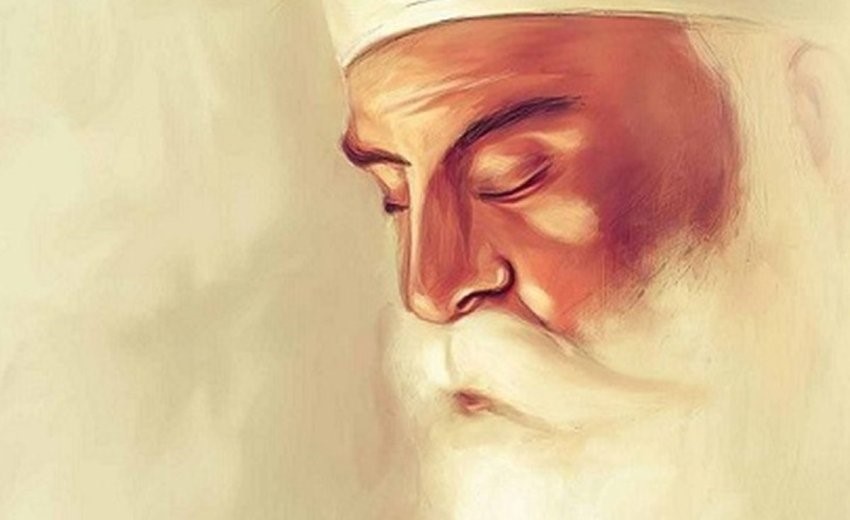
Shri Guru Nanak Dev Ji’ Gurupurab or Prakash Utsav is a celebration resonating with the profound teachings and timeless legacy of Shri Guru Nanak Dev Ji. Celebrations are marked across the world wherever the Sikh community dwells. But in recent times, other communities have joined this celebration. The birth anniversary of the spiritual luminary himself is a spectacle of devotion and festivities that will leave you in awe. Born in the year 1469, Shri Guru Nanak Dev Ji wasn’t just a historical figure – he was a beacon of spiritual enlightenment, illuminating the very path of Sikhism.
Shri Guru Nanak Gurupurab will be celebrated on Wednesday, November 5, 2025, marking the 556th birth anniversary of Shri Guru Nanak Dev Ji. That is why the full moon day of the Kartik month (October-November) is considered auspicious.
When Gurupurab approaches, “Prabhat Pheri”, a religious procession fills the ‘Amrit Vela’ with divine and spiritual energies. Prabhat means early morning, and pheri means a stroll to the house of the devotee who wishes to host the sangat of the Prabhat Pheri reciting Gurbani. Prabhat Pheri is witnessed in almost all countries across the globe with diverse participants in the sangat.
Those in deep sleep can feel the atmosphere pulsate with kirtan sung by participants of Prabhat Pheri. The procession is led by a participant from the sangat who carries the Nisha Sahib guiding the sangat from the Gurudwara to the venue of the host. After reciting Gurbani at their place and serving langar to the sangat, the host farewells the sangat. The sangat led by the leader brings them back to the gurudwara from where the Prabhat Pheri started.
Prabhat Pheri is a tradition initiated by Baba Buddha Ji. The earliest Prabhat Pheri is believed to have taken place during the imprisonment of Shri Guru Hargobind Sahib Ji Maharaj, led by Baba Buddha Ji, to show support for the Guru. The practice was later spread by Sant Baba Attar Singh Ji in the early 20th century to unite the Sikh community and promote Gurmat.
The grandeur of Guru Nanak Dev Ji Gurupurab is beyond imagination. Spiritual devotion of the sangat and the sewadaars spreads an abundance of unity, happiness and reverence.
A festival of spiritual significance
Shri Guru Nanak Dev Ji (1469–1539 CE) was born in a village called Talwandi, about 40 miles from Lahore. He was born in a family of merchants. He married and had two sons. Nanak moved to Sultanpur in his early twenties, an important town on the main road between Lahore and Delhi, where he worked as a clerk in the Lodi administration. At the young age of 28, Shri Guru Nanak Dev Ji embarked on a metamorphosis journey that eventually led him to realise that there is only one God, who is formless and accessible to all. At 30, he encountered God, which completely changed the trajectory of his coming life.
The stories Sikhs later told about Guru Nanak, called janam sakhis, recount his childhood inwardness, along with his engagement with social issues, along his remarkable encounter with God.
One day, Nanak went to bathe in a ‘Vehi’ river, accompanied by a friend. Nanak mysteriously disappeared, and his frantic friend, after several attempts to rescue him, returned to Sultanpur with the dreadful news and the clothes Nanak had left on the bank. Three days later, however, Nanak reappeared. He emerged from the water, and his first words were: “There is neither Hindu nor Muslim.” He went on to articulate that God was neither Hindu nor Muslim and so he, Nanak, would choose to follow God’s path. Guru Nanak stated his mystical encounter with God in one of his ‘shabads’.: He was taken to the court of God and given a cup of pious nectar called amrit to drink. The ‘amrit’ bestowed the gift of God’s name upon him, and he was charged by the Ultimate Power with the preaching of the Divine name.
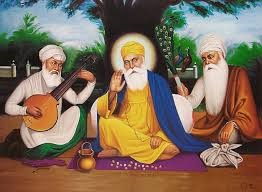
With this charge, Guru Nanak left his job and spent many years travelling throughout India and, according to early Sikh sources, even to the Middle East and beyond. He preached his message in the form of shabads, devotional hymns. According to tradition, he was accompanied by Mardana, a musician and a Muslim by birth, and ‘Bala’ a Hindu who stood by and travelled with Guru Nanak Dev ji throughout. Guru Nanak sang of the oneness of God, the equality of all people, and the futility of empty ritualism. The companionship between a Muslim (Mardana) and a Hindu (Bala) with Guru Nanak demonstrated his message of oneness, highlighting that divisions are man-made and spiritual connection is universal.
The ‘janam saakhis’ that happened among the company of his disciples displayed glimpses of the wisdom of his teachings. It is said, for example, that he went as far as Makkah. At the end of his journey, he fell asleep in the broad arcades of the holy Ka’bah of Makkah. He was shaken awake by an official who scolded him for sleeping with his feet in the direction of the holy house of God. He responded, “Then move my feet to a direction where God is not, and I will sleep with my feet in that direction.”
Eventually, Guru Nanak settled with his family in the Punjab. He farmed the fields and established a village of Sikh disciples called Kartarpur, where he continued preaching. Disciples gathered around him in a community of work and worship. His last 20 years were dedicated to the shaping of the first Sikh community. Before he left abode, Guru Nanak appointed one of his faithful followers as successor in the care and leadership of the community. He named him Guru Angad, the “limb” of Guru Nanak.
Shri Guru Nanak Dev Ji left his abode when he was seventy. According to Sikh tradition, on this day, the community gathered around Guru Nanak. Hindus insisted they should cremate his body, while Muslims wanted to bury him as a great saint. Nanak said, “Set flowers on both sides of my body—flowers from the Hindus on the right side, while flowers from the Muslims on the left. Tomorrow if the flowers of the Hindus are fresh, let my body be burned, and if the flowers of the Muslims are fresh, bury me.” He passed away and was covered with a sheet. The next day, both the Muslim and Hindu flowers were fresh, but there was no body beneath the sheet.
Shri Guru Nanak Dev ji was neither Muslim nor Hindu, though people of both traditions were drawn to him. In this, he was in the company of the mystics—the Sufi saints and the singers whose experiences of God found challenge within their established traditions after Shri Guru Nanak Dev Ji’s awakening. Guru Nanak’s divine hymns praised the One who cannot be defined by human categories or confined to human institutions. His simple path of hard work and ebullient praise eventually became an enlightened religious tradition.
Guru Nanak Dev ji’s life is characterised by compassion and a quest for spiritual truth. Shri Guru Nanak Dev Ji’s ‘janam saakhis’ (life stories) mark his profound journey, characterised by spiritual awakenings, selfless service, and unwavering devotion to those in need. Need could be worldly, spiritual or karmic. His ‘janam saakhi’s’ will make you bow your head in honour, respect and devotion with selflessness. His teachings were later compiled into the Shri Guru Granth Sahib Ji Maharaj, the holy living Guru of the Sikhs.
Shri Guru Nanak Dev Ji Gurupurab is a day set aside for reflecting on the wisdom and philosophy of Shri Guru Nanak Dev Ji. It is a time when Sikhs and people of all faiths come together to honour his teachings. During this festival, you will experience the essence of Shri Guru Nanak Dev Ji’s teachings and celebrate the presence of a spiritual guide in your life.
A glorious amalgamation of devotion and spirituality
The celebrations of Shri Guru Nanak Dev Ji Gurupurab are a beautiful merge of devotion, tradition, and joy. Soaking in the highly spiritual celebrations is an enriching experience. The festivities begin early morning as the sangat gather at Gurudwaras to offer respects and recite the pious Gurubani. Gurudwaras offer ‘Kada Prashad’, a sweet to savour the blessings and divine directions from the Almighty. Langar events take place throughout Gurudwaras and other places where voluntary community service is carried out. Langar of food, education, helping the needy and empowering communities is a sight to witness on this day. The community feast is open to all without any bias. The langar is where faith turns into action. Volunteers, known as sewadars, spend hours cooking, serving, and cleaning – all as acts of devotion. There is no hierarchy in this kitchen; everyone eats the same food, seated side by side. From business leaders to daily wage earners, everyone is equal here.
If you wish to bring a slice of this warmth home, these traditional dishes inspired by the langar can easily be made in your kitchen. The gesture of selfless service and testament to Shri Guru Nanak Dev Ji’s teachings of equality and shared humanity spreads like a divine order from the Almighty.
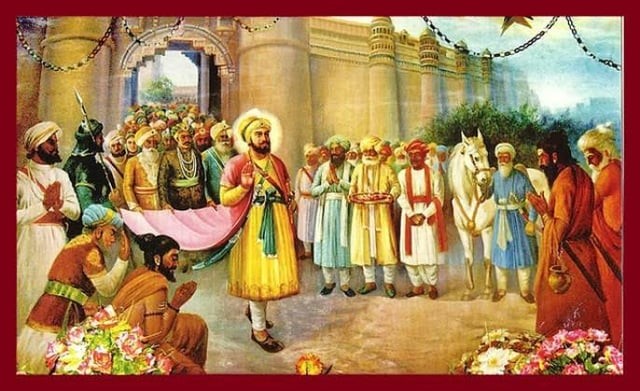
On this divinely special day, Sangat participates in the Akhand Path, which involves a non-stop 48-hour recitation of the Gurubani from Shri Guru Granth Sahib Ji Maharaj in Gurudwaras. The lively Nagar Kirtan will capture your gaze as you marvel at the procession led by the ‘Panj Pyaras’ who carry the Nishan Sahib, the Sikh flag. Soak in the blessing of unity, and happiness permeates through the ornate streets as you witness these devotional marches in full energy. Synergise with the warm and welcoming Sikh community and learn about their traditions and history!
But this is not the end of the celebration; the festivities continue well into the night in some of the gurudwaras. Shri Guru Nanak Dev Ji’s birth time is midnight at 1:20 am. You can visit gurudwaras on the previous midnight for ‘Rain Sabhai’ kirtan, where at midnight, recitation of Gurubani and continuous chant of ‘Waheguru’ mantra creates an ambience of ultimate peace.
Alongside the spiritual observance, Guru Nanak’s teachings….
Guru Nanak Prakash Utsav is not just a festival; it’s a journey into the heart of Sikhism and the timeless wisdom of Guru Nanak Dev. Come, immerse yourself in the festivities, and discover the profound message of unity, equality, and love that defines this spiritual celebration!
Guru Nanak Dev Ji, a philosopher, a poet, and a spiritual leader. He was a strong supporter and preached about the equality of mankind, compassion and devotion to one universal God.
Naam Japo- Chant God’s Name
Shri Guru Nanak Dev emphasised chanting God’s name to gain control over five evils- Kama (Lust), Krodh (Anger), Lobh (Greed), Moh (Attachment), Ahankar (Ego). He asked devotees to recite and chant God’s name—Waheguru. The Sikhs are to recite the ’Nitnem Banis’ daily in remembrance of the grace and kripa of the Almighty.
Kirat Karo- Perform work with honesty
Shri Guru Nanak Dev ji always taught that you should not exploit others to enjoy your happiness. He has always asked to honestly earn, with hard work, while accepting God’s gifts and blessings. One is to speak the truth at all times. Live a life of decency, high moral values, and spirituality.
Vand Chakko- Offer selfless service
Shri Guru Nanak always preached that we should always share what we have. The community or Sadh Sangat is an important part of Sikhism. One must be part of a community that is pursuing the values set out by the Sikh Gurus. The spirit of Giving is an important message from Guru Nanak
Celebrate Guru Nanak Jayanti across India! Witness Amritsar’s famed Sri Harmandir Sahib (Golden Temple), find peace at Delhi’s Bangla Sahib Gurudwara, or trek to the Himalayan Gurudwara Shri Hemkund Sahib for a truly unique experience. Across the globe, there are many historic Gurudwaras dedicated to the journey of Shri Guru Nanak Dev Ji. (Stay tuned for the upcoming article on “Historic Gurudwaras in India”)