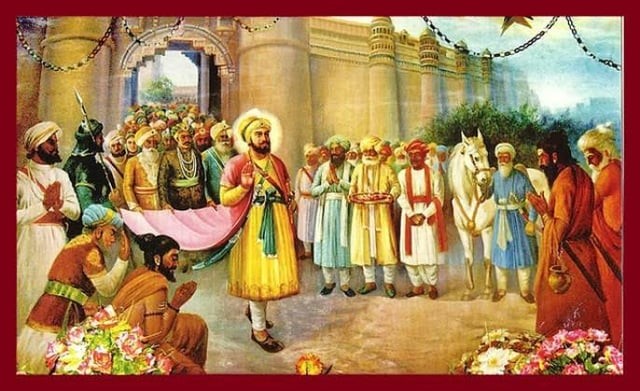
Baba Deep Singh Ji: The Sikh Warrior and an Exceptional Scholar
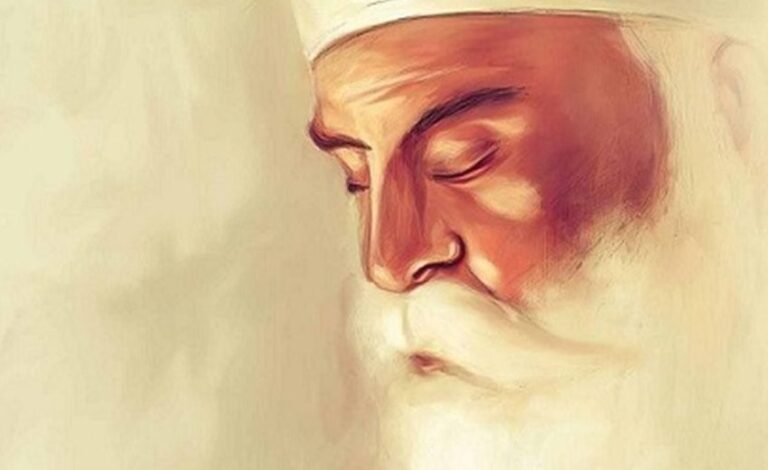
Baba Deep Singh Ji is positioned as a venerated a brave warrior, a devoted scholar, and an icon of resolute faith in Sikh history.
His life story is a testament to the enduring spirit of Sikhism, combining warrior courage and spiritual wisdom.

A Quick Look at the Prominent Milestones in the Life of Baba Deep Singh Ji
- Baba Ji was a great Sikh scholar who became a soldier and martyr for the defence of Sikhism.
- Baba Deep Singh Ji resided at Anandpur Sahib, where he spent approximately 8 years.
- He learnt Gurmukhi and several other languages from Bhai Mani Singh Ji and other sikh scholars.
- Along with language, the art of horsemanship, archery, and other arms training, like hunting and the use of bows and arrows, was an integral part of Baba Deep Singh Ji’s life.
- Between 1705 and 1728, Baba Deep Singh Ji and Bhai Mani Singh JI created several handwritten copies of the Sri Guru Granth Sahib Ji for distribution among the Sikhs.
- Baba Ji also continued to write gutkas (books of hymns), distributing them to the Sikh community.
- When 18, Baba Deep Singh Ji received Amrit from the Panj Pyare at Anandpur Sahib in the presence of the 10th Sikh Guru, Guru Gobind Singh Ji Maharaj.
- Baba Deep Sing Ji fought in various wars.
- Baba Deep Singh Ji was a survivor of the Chotta Ghalughara (Small Holocaust) in 1755. At this brutal event, 10,000 Sikhs were killed.
- At the age of 24, Baba Deep Singh Ji became the head “Granthi” at Damdama Sahib.
- In about 1709, Baba Deep Singh Ji joined Banda Singh Bahadur to combat in the battle of Sirhind.
- On the outskirts of Amritsar, Baba Deep Singh ji and a group of heavily outnumbered Sikhs fought two fierce battles against a Mughal force of 20,000.
- In the next engagement of this battle, Baba Deep Singh Ji was beheaded. But he vowed to die in the precincts of the Golden Temple. He kept his promise by continuing to fight after picking up his head and carrying it in his palm.
- On 13th November, 1757, he left for Sach Khand with his severed head resting on the parkarma of Harmandir Sahib.
- Today, at the same spot, just south of the northeast corner of the parkarma, a large marble octagonal tile marks the spot where his head landed. Many pilgrims stop and pause here daily, as they have since his death, to sprinkle rose petals and lay garlands on the tile as they pray in his honour.
Childhood and Enlightenment
Born on January 26th 1682, in Pahuwind near Amritsar, Panjab, Baba Deep Singh Ji was deeply aligned towards Sikhism and the teachings of Guru Granth Sahib Ji Maharaj. His father, Bhagta Ji, was a farmer, while his mother, Jioni Ji, nurtured him at home. But he spent most of his life in the divine shelter of the Panth (Sikh community). In his initial years, he intensely desired deep knowledge and spiritual awakening. From about 12 years of age, he grew up around the tenth Guru, Guru Gobind Singh Ji.
Baba Deep Singh Ji and Banda Singh Bahadur Ji are recognised as the most honoured martyrs of the Panth who, together, have set a benchmark for the community to follow for generations to come. Not only was Baba Ji a brave soldier, but he was also an intelligent scholar who had mastered several languages and bore excellent strategic and cognitive skills.
Joining the Khalsa
Baba ji’s life, at the age of 18, changed upon encountering Guru Gobind Singh ji Maharaj. He received Amrit and embraced Khalsa. From the time Guru Gobind Singh Ji came to Damdama Sahib, Baba Ji was responsible for distributing the Sri Guru Granth Sahib Ji to other parts of the world. He was the first “head granthi” (head priest) of Damdami Taksal (Damdama School of Learning), which happens to be a 300-year-old religious school of the Sikhs, in Bathinda. The 10th Sikh Guru, Guru Gobind Singh Ji Maharaj, formed the school. Baba Deep Singh ji bore a strong and huge build and was quite tough to challenge physically. A bold and fearless saint-soldier, Baba ji was always ready to risk his life for the Panth.
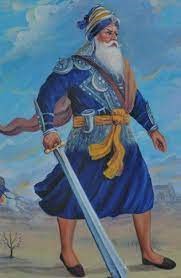
Martial Training & Leadership
Baba Deep Singh Ji began rigorous military training, where he learned various weapons and martial arts. His firm commitment to the defence of Sikhism led to his appointment as the admired leader of the Sikh army known as the Akali Nihangs. These fearless warriors were known for their bravery and fighting prowess. He was the founder of the Shahid Misl (group).
Bhai Mani Singh played a crucial role in Baba Deep Singh’s education, providing him with a deep understanding of religious scriptures. Additionally, Baba Deep Singh learned tent pegging, horse riding, and archery under Bhai Mani Singh’s guidance. This diverse training prepared Baba Deep Singh for his future journey and service to the community.
Baba Deep Singh joined Banda Singh Bahadur during the Battle of Sadhaura and the Battle of Chappar Chiri in 1709. In 1733, Nawab Kapur Singh appointed him a leader of an armed squad (jatha). The meeting of the Sarbat Khalsa in Amritsar on the occasion of Vasiakhi in 1748, the 65 jathas of the Dal Khalsa were reorganised into twelve Misls. Baba Deep Singh Ji was entrusted with the leadership of the Shaheed Misl.
With the invasion of India by Nadir Shah between January–May 1739 and the devastation of the Mughal administration in the Panjab as a result, the Sikhs saw an opportunity for themselves and sought revenge on their enemies.
Battle of Amritsar- Supreme Sacrifice
In about 1702 Guru Gobind Singh ji requested that he return to his village to help his parents. He was married that same year. In 1704, about two years after his return to Pahuwind, a Sikh messenger arrived to inform him that Guru Ji had left his fort in Anandpur Sahib after fighting with the Hindu hill Rajput Rajas for six months. He also learned that the Guru’s two young sons and his mother, Mata Gujri, was separated from the Guru during the battle. Baba Deep Singh Ji immediately left Pahuwind to meet with Guru Gobind Singh Ji upon hearing this devastating news. Baba Deep Singh Ji caught up with the Guru at Damdama Sahib in Talwandi. Here, he learned that sons of the Guru, Ajit Singh and Jujhar Singh, had lost their lives in the battle of Chamkaur. Guru Ji also told him that his two younger sons, Zorawar Singh and Fateh Singh and with grandmother were betrayed by a former family servant and arrested. After refusing to convert to Islam, they were cruelly murdered at the orders of Wazir Khan. Having pre-known the fate of younger Sahibzadas, their grandmother Mata Gujar Kaur left for heavenly abode in the thanda burj in which she and the two princes were held at Sirhind. This ordeal shook Baba Deep Singh Ji to the core.
In 1732, he went to the rescue of Sardar Ala Singh, who had been besieged in Barnala by Manjh and Bhatti Rajputs in collaboration with the faujdar of Jalandhar and the nawab of Malerkotla. In 1733, when the Mughal governor of Lahore sought peace with the Sikhs offering them a nawabship and a jagir, Baba Deep Singh and his jatha joined Nawab Kapur Singh at Amritsar to form a joint Sikh force, the Dal Khalsa, which was soon divided for administrative convenience into the Buddha Dal and the Taruna Dal, the latter being further split into five jathas. Deep Singh was given the command of one of these jathas, which in 1748 were redesignated misls. It came to be known as Shahid Misl. As the leader of the Shaheedi Misl, he achieved numerous victories for the Sikhs. The Shahid Misl had its sphere of influence south of the River Sutlej, and Baba Deep Singh’s headquarters remained at Talvandi Sabo. The tower in which he lived still stands next to the Takht Sri Damdama Sahib and is known as Burj Baba Deep Singh Shahid.
When the leaders of the Khalsa Panth (Misaldars) came to know of this caravan passing through the Panjab, they decided to intervene with force, to free these girls and women and save their honour and that of the country. The cries for help of these unfortunate women fell on deaf ears, and nobody dared to rescue them till the caravan arrived near Kurukshetra. Baba Deep Singh’s Jatha (army) was assigned duty near the river Markanda. When he and his brave companions heard the wailings of the helpless children and women, they stormed out of the surrounding jungles (forests) and pounced upon Abdali’s caravan, like lightning bolts from an angry sky. While some of them attacked Abdali’s soldiers, others captured and drove away many bullock carts laden with the children, women and looted valuables, taking them to the safety of their nearby jungle hideouts.
With little thought of their own safety or lives, the Sikhs had rescued about 300 women and young girls, as well as 100 boys, from the clutches of Abdali. The freed boys, girls and married women, both Muslim and Hindu, were escorted safely to their homes by the Sikh soldiers. Men whose moral character was of the highest order, even in those difficult days.
The Rajput and Maratha Khatris had failed to make any attempt to rescue the prisoners. But it was the saints-soldiers of Guru Gobind Singh who dared to stand against all odds. This spirit of courage, valour and fearlessness made Ahmed Shah wonder in shock and surprise.
The final realm of sacrifice
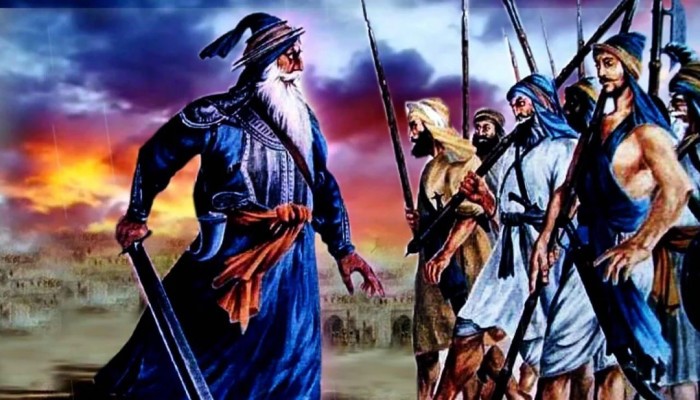
Ahmad Shah Durrani took over Panjab to his Afghan dominions and appointed his son, Taimur Shah, viceroy at Lahore, with the veteran general Jahan Khan as his deputy. Jahan Khan attacked Amritsar in May 1757, razed the Sikh fortress of Ram Rauni and dishonoured the sarovar (sacred pool). At 75, Baba Deep Singh Ji had the strength of a young warrior. He advanced towards Harmandir Sahib by gathering a large group of Sikhs and Sikh warriors. Upon reaching the village of Tarn Taran, their numbers had risen to about five thousand. At this point, Baba Ji drew a line on the ground with his khanda. He asked only those who were willing to fight and die must cross the line.
All the assembled Sikhs crossed the line eagerly. Baba Deep Singh Ji then recited the Shabad:
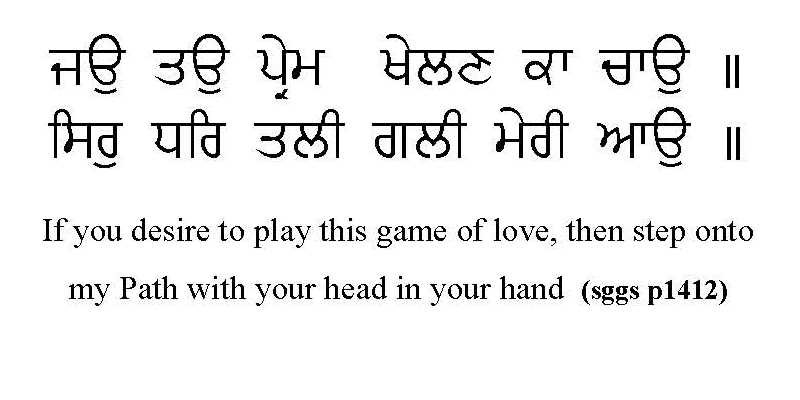
“Jo to prem khelan ka chaao, sir dhar talee galee meri aao.”
Those who wish to play the game of love (to follow the Sikh path), come to me with your head in your palm.
“eith maarag pair dhareejai, sir deejai kaan na keejai.”
Once you have your feet on this path, don’t delay in giving your head.
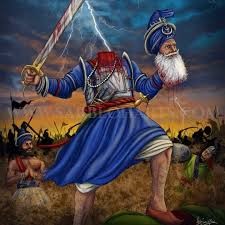
Baba Deep Singh holding his severed head in his left palm
When news of Baba Deep Singh Ji’s intentions reached Jahan Khan, he immediately mobilised an army of 20,000 men and proceeded towards Tarn Taran. Baba Deep Singh Ji’s army intercepted Jahan Khan’s forces near the village of Goharwal, about five miles from Amritsar. Baba Deep Singh Ji was adorned with his 15kg (about 32 lbs.) khanda (double-edged sword) to fight the battle fiercely. During the midst of battle, a large army of reinforcements arrived for Jahan Khan’s men, turning the odds against the Sikhs. Each Sikh fought with such great valour and courage that the enemy was almost defeated. Sikhs with Baba Deep Singh Ji as their head continued fighting and advanced towards Amritsar.
During the battle, Jamal Khan, one of the Mughal commanders, attacked Baba Deep Singh Ji. As they fought, both men swung their weapons with great force, leaving both of their heads separated from their bodies. After seeing this scene, a young Sikh warrior called out to Baba Ji, reminding him of his vow to reach Sri Harimander Sahib. Upon hearing this, Baba Deep Singh Ji immediately stood up, holding his severed head upright on his left palm while holding his khanda in his right hand. He then continued fighting (with strength derived from the recitation of JapJi Sahib) and moving towards Sri Harimander Sahib. Upon seeing the sight of Baba Deep Singh’s headless body tearing through their numbers, most of the men in the Mughal army fled away in terror.
Baba Deep Singh was able to continue fighting and fulfilled his oath on finally reaching Sri Harimander Sahib – there he bowed and laid his head on the parkarma of this sacred Gurdwara. The Sikh Army continued to fight the fleeing Mughals until victory was achieved. Baba Deep Singh ji is remembered by all Sikhs as a brave martyr with an unflinching dedication to the Sikh principles.
Scholarly Contributions
His martial prowess is a highly decorated characteristic of Baba Ji’s personality. But he was also a scholar of profound wisdom. He dedicated himself to the study of Sikh scriptures and played a key role in the preservation and spreading of Sikh teachings.
His devotion helped ensure the authority and accuracy of the Guru Granth Sahib, the central religious scripture of Sikhism.
Legacy of the mental, physical and spiritual strength
Baba Deep Singh Ji’s legacy continues to be an inspiration to Sikhs and people around the world.
His commitment to Sikh principles of equality, justice and the protection of religious freedom continues to be a guiding light of courage and strength.
His spirit of selfless service and faith continues to motivate people who seek a deeper connection with their faith and a stronger commitment to righteousness and justice.
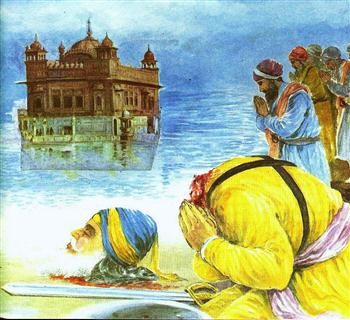
Shrines that commemorate sacrifice and valour
One is on the circumambulatory terrace of the Sarovar surrounding the Harimander Sahib, where he finally fell. The place rests with powers of incredible dedication and determination.
The second shrine is the very place, Shahidganj Baba Deep Singh Shahid, near Gurdwara Ramsar, where his body was cremated. The places where Baba Deep Singh Ji drew the line, engaged in battle, lost his head, threw it, and where it landed are all marked by historical Gurdwaras in Panjab.