Nature’s hilarious story
Nature’s hilarious story
Nature has designed everything so perfectly that it often leaves us astonished—wondering how, why, by whom, and from what raw material such exquisite systems were created. This perfection extends to all living beings: birds, insects, animals, bacteria, viruses—everything. Humans, of course, are included too.
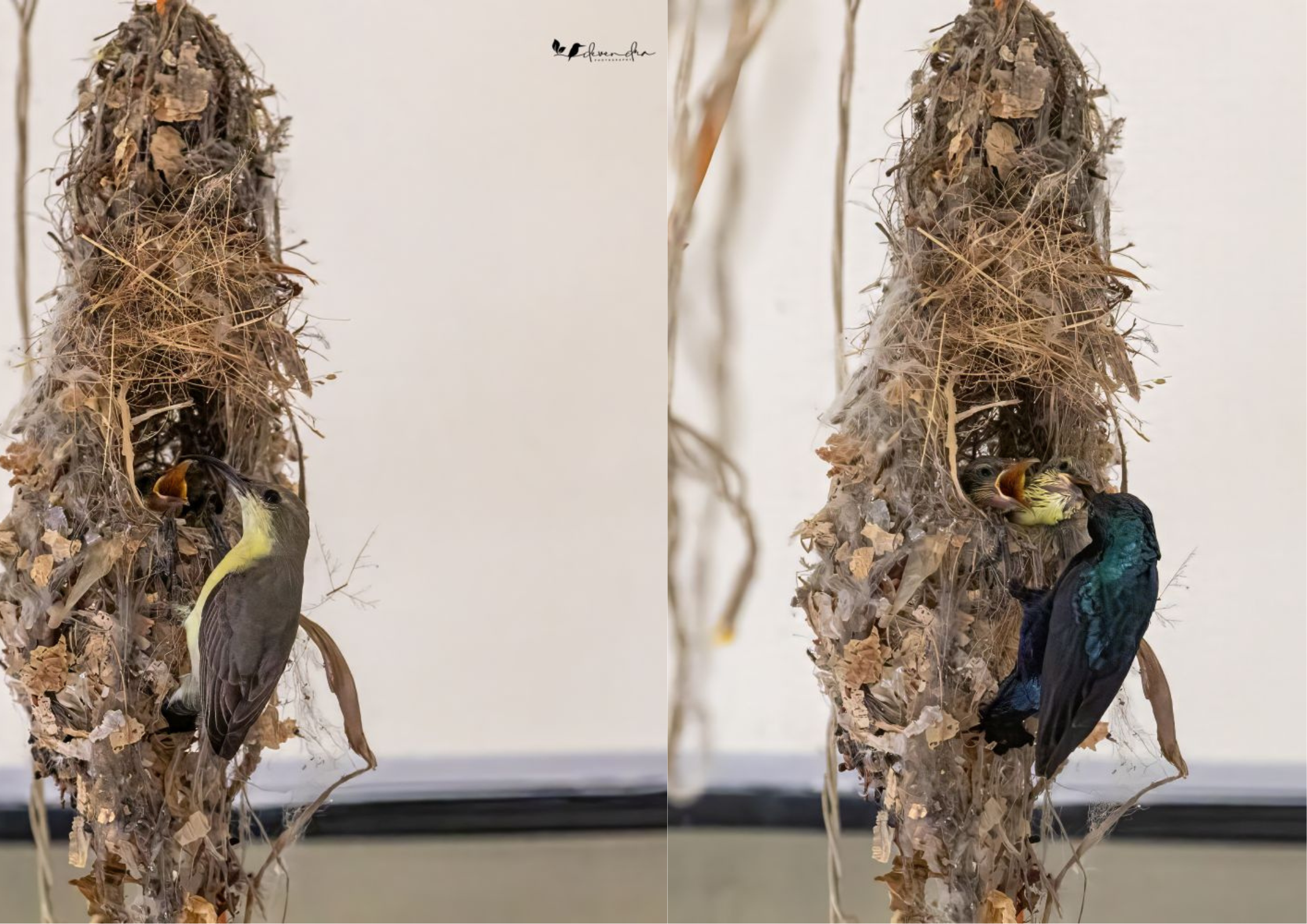
On one such occasion, I witnessed a delightful and rather humorous episode involving the Purple Sunbird—a tiny bird weighing barely nine grams. The male is a dazzling, glossy purple, while the female is modestly dressed in dull colours. Together, they create one of the most beautiful little nests one can imagine.
Unlike many birds, the Purple Sunbird male is polygamous, meaning he may have more than one partner. Interestingly, the female too is polyandrous and may choose more than one mate. Nature, it seems, has its own rules—unapologetic and fascinating.
A pair of Purple Sunbirds chose our balcony as their nesting site. Twice—once in May and again in June—they used the same nest to raise their young. On each occasion, two chicks were born, making it four chicks in just a month and a half. Watching this unfold was pure joy.
After the eggs were laid, the female remained almost constantly inside the tiny nest, patiently incubating them. The male, ever alert, kept visiting to check that everything was in order. Once the chicks hatched, their growth was astonishingly fast. The female cleaned the nest and tended to the chicks, while both parents worked tirelessly—visiting the nest nearly a hundred times a day to bring food and remove waste. This entire exercise, from hatching to fledging, took about fifteen to eighteen days. When the chicks were confident enough, they simply flew away, ready for the world.
Observing such dedication and relentless hard work by the parents was deeply fulfilling. It was nature’s classroom, open and generous.
And then came the humorous twist.
After successfully raising two batches of chicks, the male Purple Sunbird returned one day while I was standing near the neem tree by the balcony. He kept flying back and forth—from the tree to the nest, circling repeatedly. At first, I couldn’t understand what he was up to.
Soon, the mystery revealed itself.
He had brought along two fresh female partners.
With great pride, he began showcasing his “palace”—his nest. He flew into it, came out, went back to the tree, and returned again, as if saying, “Look at this magnificent estate!” One female arrived first and inspected the nest carefully. Then the second one came and examined it too. The male hovered around confidently, clearly ready for a third round of parenting.
I stood there amused, thinking: This fellow has already raised four chicks in record time, and now he is gearing up for the third batch! *
It was difficult to “fool” too many females.
But nature had other plans.
Perhaps the females sensed that the nest had already housed two other females. Perhaps they read the invisible history written into its fibres. Whatever the reason, they politely declined the offer and chose to seek greener pastures—somewhere else, someone else.
The expression and behaviour of the male were nothing short of hilarious—earnest, hopeful, and slightly bewildered. His grand plan failed.
Yet, what a story nature tells us.
Such moments are nothing less than miracles—rich with lessons, humour, and humility. Experiences like these cannot be bought with money. They can only be earned by being observant, patient, and kind to nature.
So let us be appreciative.
Let us be protective.
Let us preserve and promote the natural world.
After all, we have only one Earth to live on—at least for now.